The lights are out, the WiFi router is turned off, and suddenly the fridge is silent in the kitchen. To most Nepali families, this is not an uncommon inconvenience, but rather a normal part of everyday life, due to the blackouts, maintenance in the grid, and fluctuating loads during the monsoon season. The problem is, you don’t ask yourself whether you need backup power. Instead, the real question is which is the best generator for home backup power in Nepal that fits your household and budget.
This guide will help you make your decision transparent without any jargon and without any guesswork so you can leave this decision with your answer of what “best” means to your household.
Quick Answer
The best generator for home backup power in Nepal is one that matches your appliance load (approximately 5 kVA to 12.5 kVA for most homes), offers excellent fuel efficiency, and comes with reliable after-sales service. Kirloskar generators such as the EA-Series or HA-Series are among the most dependable options for home backup generators in Nepal.
Why Every Nepali Home Needs a Backup Power Plan?
Even with the advancements in power supply on a national scale, there are still blackouts that happen during harsh weather conditions, festivals that bring about high demands, or scheduled maintenance of substations. The purpose of installing a backup generator goes far beyond being comfortable to guarantee the safety of:
- The refrigerated food and medication do not rot during a power outage lasting several hours.
- Work from home and classes remain unaffected without any disruptions.
- The water pumps continue working, which becomes more important than most people realize after the tank is empty.
- Security system, cameras, and routers remain operational, especially during the nighttime.
A properly selected and sized generator will not be noticeable in your daily life. An incorrectly selected one will either be inadequate for your house or become an unneeded financial burden.
Common Mistakes Homeowners Make When Choosing a Backup Generator
Before discussing sizing, some common errors people commit have to be considered. Simple avoidance of these errors will help one get to 80% of making the right decision.
Sizing by guesswork, not by load
Selection based on the appliance used by the friend/shopkeeper but without considering the household load requirements. An engine that works well for a two-bedroom house cannot possibly meet the demands of a household using the borewell pump and air conditioning.
Ignoring startup surge
Motors used in refrigerators, water pumps, and ACs need more power when starting up than when running. A generator built for the “running load” will stop as soon as the appliance is started.
Choosing on price alone
Purchasing the cheapest generator for house use in Nepal without checking whether spare parts are available locally or whether trained technicians can provide service.
Skipping installation planning
An installation of the generator on an unventilated balcony or near a bedroom window results in complaints about noise and exhaust, which could have been avoided at the initial stage of planning.
Overlooking warranty and after-sales terms
The generator is a long-term purchase, not merely a purchase. The capability of the dealer to service it over the next 10-15 years is quite important as well as the generator itself.
What Actually Makes a Generator “Best” for Home Use?
There is no single best diesel generator for home that suits every family. This will depend on your needs; therefore, a perfect generator will be found by considering the following points:
- Capacity (kVA rating) — depending on your actual simultaneous use of the appliance and not necessarily the number of appliances you have.
- Fuel type — which could be either diesel or petrol or both.
- Noise output — very important when living in a residential area surrounded by neighbours.
- Run time and fuel efficiency — how long can it power your house with every liter of fuel or fuel tank.
- After-sales support — genuine spare parts and a technician who can reach your home quickly matter more than most buyers realize until something goes wrong.
How to Calculate the Right Generator Size for Your Home?
Proper generator load calculation helps you choose the correct generator size while avoiding unnecessary fuel costs and equipment problems. Undersizing means tripped breakers and appliances that won’t start. Here’s a simple way to estimate what you need.
Step 1: List what you want to run during an outage
| Appliance | Approx. Running Load |
| Lights (LED, per bulb) | 10–15 W |
| Ceiling fan | 70–90 W |
| Refrigerator | 150–300 W (higher on startup) |
| Television | 80–150 W |
| Wi-Fi router | 10–20 W |
| Water pump (0.5 HP) | 400–500 W |
| Washing machine | 500–1,200 W |
| 1.5-ton air conditioner | 1,500–1,800 W |
| Microwave oven | 1,000–1,500 W |
Step 2: Add a startup-surge buffer
Total the wattage of all the appliances that you will use at the same time, and add 25-30% to take care of the starting surge that is needed when the motors start.
Step 3: Convert to kVA
By way of general principle, take your wattage and divide by 800 to find the kVA rating (which allows for the usual power factor).
What this looks like in practice
For the majority of households in Nepal, consisting of lighting facilities, refrigeration, fans, water pumps, and some electronics, generators of 5kVA to 7.5 kVA will be enough. Those larger houses that operate one or two air conditioners in addition to other appliances will require generators of 10 kVA to 12.5 kVA. In case of doubt about the capacity required, it’s better to have a load assessment done by a dealer rather than guessing and making the same mistake of buying too much.
Diesel vs Petrol vs Inverter Generators: Which Suits a Home?
Choosing the right fuel type is one of the most important decisions when buying a diesel generator for home or another backup solution.
| Factor | Diesel | Petrol | Inverter |
| Best for | Regular, longer outages | Occasional, short backup | Sensitive electronics, low noise needs |
| Fuel efficiency | High | Lower | Moderate to high |
| Running cost | Lowest per hour of use | Higher | Moderate |
| Noise level | Moderate (varies by enclosure) | Moderate to high | Low |
| Lifespan | Long, built for continuous duty | Shorter under heavy use | Long, lighter duty cycle |
| Typical home use case | Whole-home backup | Small/portable backup | Laptops, routers, medical devices |
Nepalese homes that are subject to frequent power cuts should use diesel generators, which are designed for a longer duty cycle, are cheaper to operate, and last longer in terms of durability. The use of petrol generators is recommended in cases where there are smaller and infrequent power cuts, while inverters can be useful for delicate electronic devices.
Air-Cooled vs Liquid-Cooled: Which Is Better for a Home?
This distinction matters more than most buyers realize:
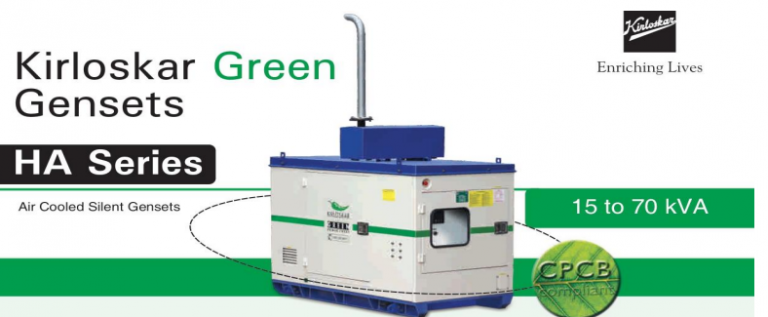
- Air-cooled generators (with power capacity ranging from 5 to 70 kVA) are small in size, easy to set up, and require little maintenance, making them perfect for use on rooftops, terraces, and small compounds.
- Liquid-cooled generators operate at lower temperatures during high continuous loads and are suited for larger houses, office buildings, or areas where there is a need for constant back-up.
In the case of a single-family house, the air-cooled generator will be the better option. Liquid-cooled generators will only make sense if you are using the generator for a long period of time.
Generator vs Inverter Battery Backup vs Solar: What’s Right for a Nepali Home?
Generators are not the only form of backup, and it’s best to know how they stack up against other forms of backup.
Inverter/battery backup
The electrical energy from the grid is stored in battery form and released quietly when there is no power available. Perfect for short-term power failure that lasts a few minutes to a couple of hours, but good only for operating such devices as lights, routers, and computers because of no noise and no emission of carbon monoxide. However, they are not enough to drive pumps, washing machines, or air conditioners due to the large batteries required and total dependence on power coming back.
Solar-battery systems
Solve the issue of battery recharging by producing their own power, which would make them ideal for homes that have consistent sunlight during the day and the capacity to invest initially. The disadvantage would be the higher initial investment and lower production during the monsoon season in Nepal when outages occur frequently.
Diesel generators
Continue to be the most reliable method for houses requiring high energy requirements during unforeseen and lengthy power cuts, as their efficiency does not depend upon the level of charge of a battery nor on the level of sunlight on that particular day. They provide a steady supply of energy depending upon the availability of fuel, which is why they continue to be the preferred choice of Nepalese houses having pumps and refrigeration.
In reality, many homes end up settling on a system that incorporates both types: an inverter and battery for quiet and brief power disruptions, along with a generator sized for longer or harder outages. For those looking to build an entire backup solution as opposed to simply replacing one appliance, it’s useful to talk about your home’s outage profile with a retailer first.
What a Home Generator Really Costs Beyond the Purchase Price?
The sticker price is only one part of the equation. When comparing options, factor in:
- Fuel consumption per hour varies based on the load; a generator operating at 50-75% of its rated capacity will be much more fuel-efficient than a generator running close to idle speed or close to maximum capacity. This is one of the reasons why proper sizing is important for cost-effectiveness.
- Routine servicing — regular oil and filter changes and periodic checkups by qualified mechanics, which are much cheaper and more predictable than repair costs incurred from neglecting a machine.
- Spare parts availability, which is related to costs and speed of fixing the machine. Genuine spare parts from an authorized dealer will last longer and be more valuable for resale compared to unbranded alternatives, despite being initially more costly.
- Expected lifespan: a well-built, well-maintained diesel generator can reliably serve a home for well over a decade, spreading the initial investment across many years of use.
For a full breakdown of current pricing by capacity and model, see our detailed generator price guide for Nepal.
Recommended Kirloskar Generators for Home Backup
Small apartment or 2–3 room home
Kirloskar EA-Series (5 kVA–12.5 kVA) — Compact and easy to install; suitable for necessary lighting, fans, fridge, and router.
Mid-sized independent home
Kirloskar HA-Series air-cooled generator (15 kVA–70 kVA range, scaled to need) — Capable of providing power to a water pump, washing machine and a few split ACs.
Larger homes or homes with heavy appliance use
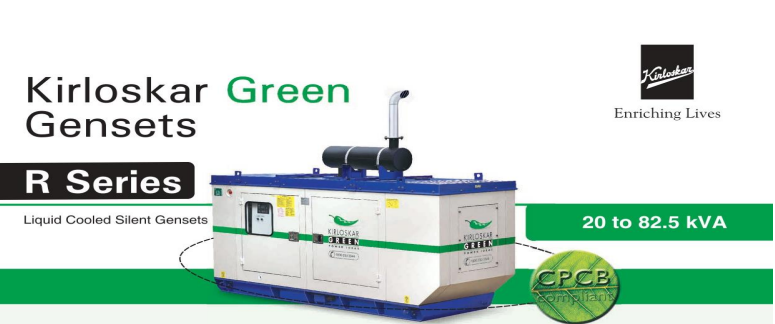
Kirloskar R-Series (20 kVA–82.5 kVA) — Reliable and liquid-cooled generators suitable for homes that depend on the generator daily instead of just using it as backup.
If you’re weighing exact models against your budget, our detailed Kirloskar generator price guide and Kirloskar Green buyer’s guide break down pricing and specifications model by model.
Must-Have Features in a Home Backup Generator
- Automatic Transfer Switch (ATS) – Generator starts in a few seconds of power failure without requiring any action from you.
- Acoustically soundproof canopy – maintains sound levels below the residential area permissible limit.
- Shutdown due to low oil/low fuel level – ensures automatic engine protection.
- Locally available genuine spare parts – your generator’s reliability depends on the servicing offered to it.
- Smaller physical dimensions – more relevant for houses with restricted terrace/auxiliary space.
Backup Power Needs Across Kathmandu, Chitwan & Butwal
The power requirements for a house in Nepal vary depending on the area, and it would be worthwhile taking into consideration the local situation when it comes to selecting the capacity and set-up.
Kathmandu Valley
Houses are usually constructed near each other, with limited area for terraces or yards. The air-cooled, sound-isolated generator of 5-12.5 kVA capacity becomes an appropriate choice, both in terms of space limitations and in terms of noise level friendly to the neighbours in densely populated areas.
Chitwan
Due to its relatively warm climate for most of the time of the year, it is characterized by increased cooling loads from fans and air conditioning, which increases the number of people choosing a generator of 7.5-15 kVA capacity to handle extra load.
Butwal and the wider Terai belt
Share the same heat-based demand with some voltage variations, thus requiring a reliable and properly regulated diesel generator to protect your gadgets from power problems.
The offices of BRT International in all three areas ensure that load calculation, installation, and maintenance will be done by a technician who understands the local conditions rather than making general recommendations.
Installation & Safety Tips for Home Generators
- Must be installed on a flat and well-ventilated area but never in an entirely enclosed room.
- Do not direct the exhaust near any window, door, or surrounding buildings.
- Have a certified electrician perform the connection to your home electrical circuit never connect directly to a wall socket.
- Diesel fuel must be stored in proper containers and not in living areas.
- Monthly testing is recommended even in the absence of power failure.
Maintenance Checklist for a Reliable Home Generator
- Oil level must be checked monthly, but oil replacement is recommended on a period advised by the manufacturer.
- Air filter should be checked and either cleaned or replaced periodically, especially during the pre-monsoon season of Nepal.
- Battery terminals must be checked for corrosion.
- The fuel tank needs to be kept full at all times because driving with little fuel could make dirt enter the fuel pipe.
- Maintenance work should be done annually even though everything seems fine.
Final Thoughts
The best generator for home backup power in Nepal is not necessarily the largest or the cheapest. It is the one that matches your home’s electrical load, provides reliable performance during outages, and comes with dependable after-sales support. Choosing a quality Kirloskar Green generator from an authorized dealer ensures long-term reliability and peace of mind.
Need help sizing the right generator for your home? BRT International has been Nepal’s authorized Kirloskar Green dealer since 2007, with branches in Kathmandu, Chitwan, and Butwal. Get in touch for a free load assessment and a generator recommendation built around your actual home, not a generic size chart.
Frequently Asked Questions
1. What is the best backup generator for a home?
The ideal generator for a domestic setting should be correctly sized to match the load of appliances at home, run on an appropriate fuel type according to how frequently there are power cuts, and be provided by a service provider able to service the equipment locally. For a Nepalese house, this would be a diesel generator ranging from 5 to 12.5 kVA.
2. What size generator do I need to power my whole house?
This depends on the kind of things that you wish to operate together. You will need to calculate the total wattage of your biggest appliances, add a buffer of 25-30%, then convert into kVA. Most houses range from 5 kVA to 12.5 kVA.
3. How many kVA generator do I need for a home in Nepal?
In Nepal, a normal house which has lights, fans, a refrigerator, and a water pump will require 5-7.5 kVA. If there is air conditioning or additional appliances, then it would require 10-12.5 kVA.
4. Is it worth buying a generator for home backup?
Yes, if you have frequent power outages, it ensures that food and medications are refrigerated, water pumps keep operating, and the alarm system is up and running without being interrupted by loss of power when you are working, studying, or spending time with your family.
5. Can a home generator run 24 hours a day?
Generators used at home are not designed to run continuously on a 24-hour cycle. The machines require a break from time to time, oil changes, and cooling. If one intends to run a generator almost continuously, the liquid cooled one should be preferred.
6. What is the difference between a portable and a standby generator?
The portable generator is relocated and connected manually whenever it is required, while the standby generator is permanently installed and connected to the home’s electrical wiring system. The standby generator is able to start itself in a few seconds during a power failure using the Automatic Transfer Switch (ATS).
7. How much fuel does a home generator use per hour?
Fuel consumption varies based on the size of the generator and its load; however, maximum efficiency occurs when a generator operates at 50-75 percent of its capacity. Running the generator too close to idle or full-load settings wastes fuel.
8. Is a diesel generator better than a petrol generator for home use?
For those homes that experience a lot of outages, diesel is recommended because it is more fuel-efficient, has a higher capacity, and is cheaper in terms of running costs. The use of petrol is only recommended for small generator use.
9. How long do home backup generators last?
Properly designed and maintained diesel generators are able to work for a period of more than ten years. The durability of generators is mainly determined by the maintenance performed.
10. Where is the safest place to install a generator at home?
In an open, ventilated space outside the house, away from windows and doors, and in a place far away from any adjacent property. It is not advisable to install a generator in a completely enclosed room.
11. Can a generator damage my home appliances?
A generator with inadequate capacity and unstable voltage regulation could lead to fluctuations in the supply of electricity, damaging any delicate appliances. Selecting an appropriately-sized generator with stable voltage regulation and installing a transfer switch would protect your appliances.
12. How much does a home backup generator cost in Nepal?
Cost varies by capacity, brand, and cooling type (air-cooled vs liquid-cooled). For a full breakdown by kVA and model, see our generator price guide for Nepal.
Popular Posts
Recent Posts
-
Kirloskar R Series vs SL Series: Which Generator Is Right for You?
Oct 06, 2026 | admin
-
Generator Overheating: Causes, Quick Fixes and Prevention Tips (Nepal Guide)
Oct 02, 2026 | admin
-
Diesel Generator Working Principle: The Complete Guide (2026)
Sep 27, 2026 | admin
-
Common Generator Problems in Nepal: Causes, Solutions, and Maintenance Tips
Sep 23, 2026 | admin
-
Generator Installation Cost in Nepal (2026): Complete Pricing & Buying Guide
Sep 10, 2026 | admin
-
IoT Enabled Genset: How Smart Generators Can Reduce Fuel Costs in Nepal
Sep 06, 2026 | admin
-
kVA vs kW: What’s the Difference? Simple Generator Power Guide
Sep 03, 2026 | admin
-
Best Generator for Hotel in Nepal (2026): Sizing, Silent Operation & Buying Guide
Aug 27, 2026 | admin