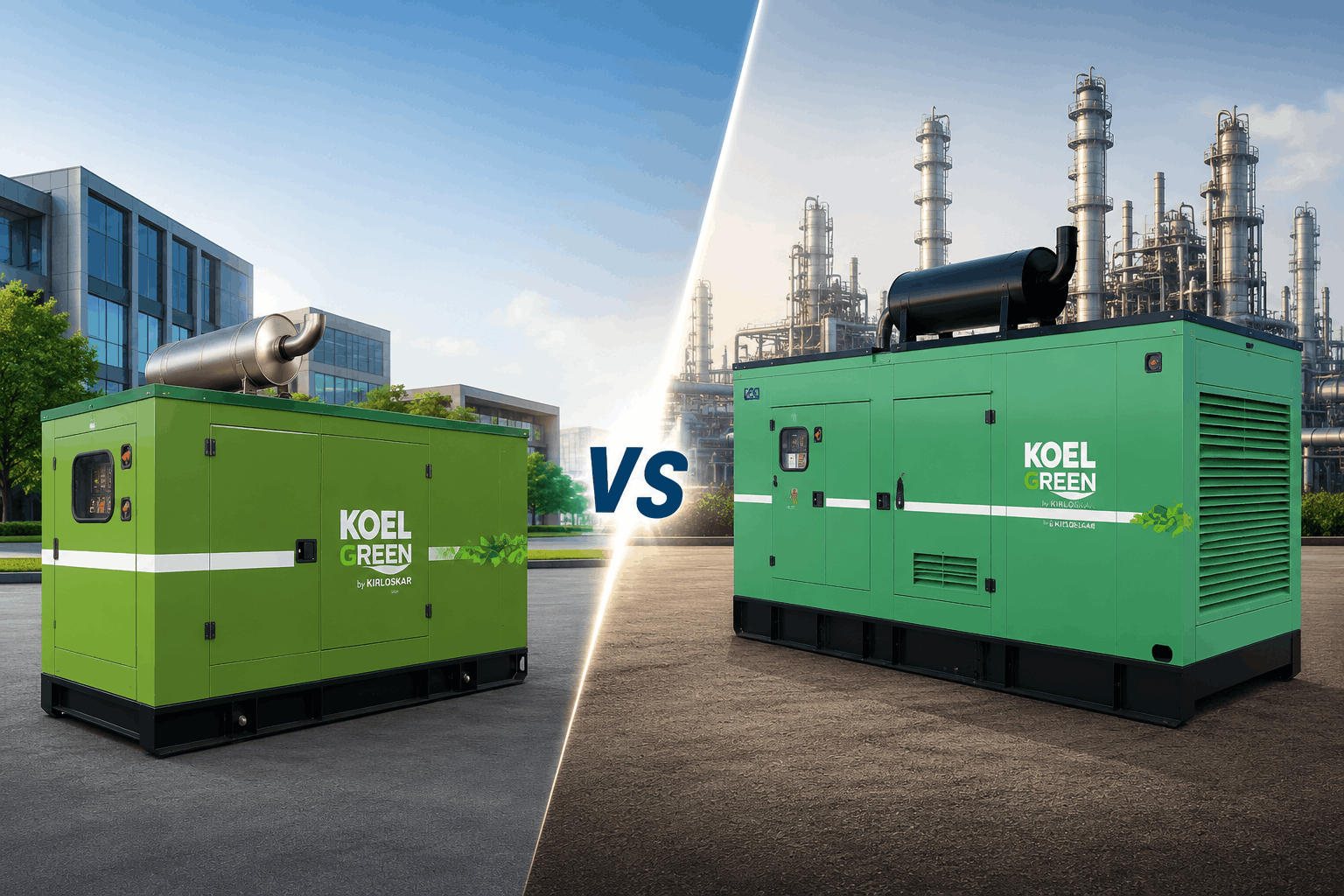
Choosing the right diesel generator is not only about choosing a trusted brand. You also need to select a generator that matches your power requirement, operating environment, available space, and future needs.
Both the Kirloskar R series and Kirloskar SL series generators are diesel-powered generators that use liquid cooling. Nevertheless, they serve different power needs. This guide to Kirloskar R Series vs SL Series will help you choose the right one for your site.
The R Series spans from 20 kVA to 82.5 kVA and is applicable in smaller commercial and institutional settings, among others. On the other hand, the SL Series ranges between 180 kVA and 250 kVA and is designed for bigger commercial and industrial uses.
So, which one should you choose?
The answer depends mainly on your actual load requirement.
Quick Answer: Kirloskar R Series vs SL Series
If you need a generator between 20 kVA and 82.5 kVA, the Kirloskar R Series is the more suitable range to consider.
If your requirement is between 180 kVA and 250 kVA, the Kirloskar SL Series is designed for higher-capacity applications.
Here is the Kirloskar R Series vs SL Series comparison at a glance:
| Feature | Kirloskar R Series | Kirloskar SL Series |
| Power range | 20–82.5 kVA | 180–250 kVA |
| Cooling | Liquid cooled | Liquid cooled |
| Fuel | Diesel | Diesel |
| Engine configuration | 2, 3 and 4 cylinder options | 6-cylinder |
| Voltage | 415 V | 415 V |
| Frequency | 50 Hz | 50 Hz |
| Best suited for | Commercial, institutional and medium-load applications | Large commercial and industrial applications |
| AMF option | Available | Available |
| Synchronization | Available as an option | Available as an option |
| Controller | KG 934 | KG 545 |
| Oil change interval | Up to 500 hours* | Up to 500 hours* |
*Exact specifications and service intervals can vary by model and operating conditions. Confirm the final specification with BRT International before purchase.
What Is the Kirloskar R Series?
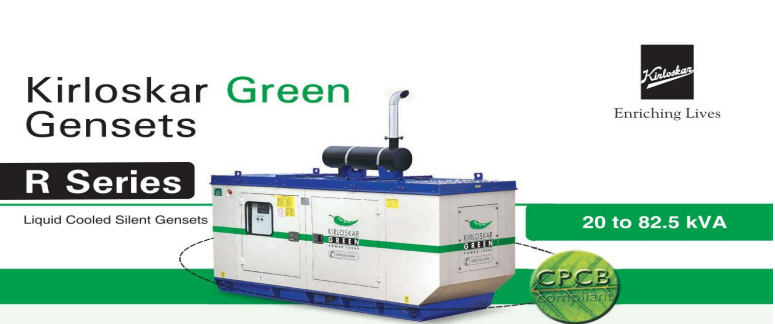
Kirloskar R Series is a range of liquid-cooled diesel generator sets ranging between 20 and 82.5 kVA.
According to BRT International, there are different models of this range, including 20, 25, 30, 40, 50, 62.5 and 82.5 kVA generator sets. The R Series generator sets have compact engines that have 2, 3 or 4 cylinders.
The R Series is specifically meant for people requiring reliable generator sets without upgrading to the higher category of generator sets.
Key Features of the R Series
- 20 kVA to 82.5 kVA capacity
- Liquid-cooled engine technology
- Compact design
- 415 V, 50 Hz output
- Electronic AVR for voltage regulation
- Microprocessor-based KG 934 controller
- AMF capability
- Remote monitoring and remote start/stop options
- Synchronization option for multiple gensets
- Acoustic enclosure
- Up to 500-hour lubricating oil change interval, depending on model and conditions
Where Is the R Series Used?
The R Series can be considered for applications such as:
- Offices
- Retail shops
- Restaurants
- Clinics and institutions
- Schools
- Small hotels
- Commercial buildings
- Workshops
- Telecom applications
- Medium-load backup requirements
The exact generator size should still be selected after calculating the site’s electrical load.
What Is the Kirloskar SL Series?
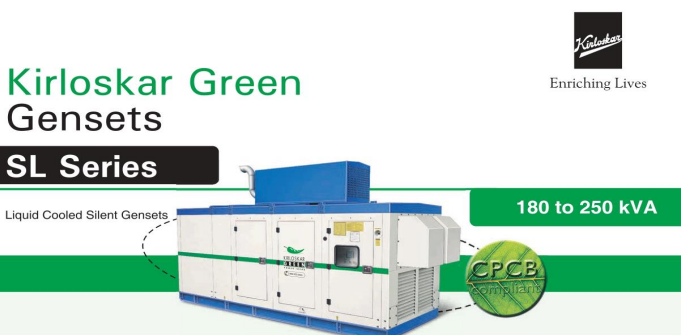
The Kirloskar SL Series is a range of liquid-cooled diesel generator sets designed for higher power requirements. The range covers 180 kVA to 250 kVA and is suitable for large commercial, industrial, and institutional applications.
The SL Series uses a 6-cylinder engine with turbocharged and aftercooled technology. It is built for applications that require reliable power for larger loads, such as hospitals, hotels, shopping centers, factories, and large commercial buildings.
Key Features of the SL Series
- Capacity of 180 kVA to 250 kVA
- Engine with six cylinders, liquid-cooled
- Electricity generation of 415 V and 50 Hz
- Turbocharged and aftercooled engine
- KG 545 advanced genset controller
- Inbuilt AMF feature
- Remote control and BMS capability
- Synchronizing and paralleling capability
- Weatherproof enclosure
- Lubricating oil change of up to 500 hours, dependent on model and conditions
Where Is the SL Series Used?
The SL Series is more appropriate for larger installations including:
- Factory premises
- Hospitals
- Hotel complexes
- Shopping centers
- Larger commercial buildings
- Corporate complexes
- Institutions
- Industrial premises
The increased output capacity makes the SL Series more appropriate where the loads connected and operating at the installation are considerably higher than what is required from an R Series generator.
Kirloskar R Series vs SL Series: Main Differences
The biggest difference between the two ranges is power capacity.
The R Series is designed for requirements from 20 to 82.5 kVA, while the SL Series starts at 180 kVA. This means you should not select between them based only on features or price.
Your first question should be:
How much power does my site actually need?
1. Power Capacity
The R Series covers:
20 kVA → 25 kVA → 30 kVA → 40 kVA → 50 kVA → 62.5 kVA → 82.5 kVA
The SL Series covers:
180 kVA → 200 kVA → 250 kVA
There is a significant gap between the two ranges. If your requirement falls between 82.5 kVA and 180 kVA, do not automatically choose the larger SL Series. BRT can recommend another suitable Kirloskar model from its wider product range.
BRT’s current product lineup also includes the DV Series from 320 kVA to 625 kVA, along with other generator ranges.
2. Engine Size and Configuration
The R Series uses compact 2-, 3- and 4-cylinder engine configurations, depending on the model.
The SL Series uses a six-cylinder engine for its higher power output.
This difference reflects the amount of power each series is designed to produce.
A higher-capacity generator generally requires more installation space, heavier electrical infrastructure and more careful site planning.
3. Physical Size and Installation
The physical requirements of a generator should never be ignored.
An R Series generator is generally easier to accommodate where space is limited. However, it still requires proper ventilation, exhaust arrangements, access for maintenance and a suitable installation base.
The SL Series requires considerably more installation space. For example, BRT lists the acoustic enclosure dimensions of its SL Series at approximately 4940 × 1700 × 2050 mm, with weight varying by model.
Before purchasing an SL Series generator, check:
- Generator room dimensions
- Access for delivery
- Foundation requirements
- Ventilation
- Exhaust routing
- Cable routing
- Fuel storage
- Maintenance access
- Lifting or handling requirements
A generator should be selected based on both its electrical requirement and its physical installation requirements.
Which Series Is Better for Your Application?
Neither one wins every time. It comes down to what you plan to run.
Offices
A small or mid-size office usually doesn’t need much power. Lights, computers, a router, a few ACs. An R Series set often covers all of that.
Things change in a tall building. Several floors, a couple of lifts and a big HVAC system add up fast. At that point you’ll likely need something larger.
Hotels
No two hotels use power the same way.
A small hotel with a few dozen rooms can usually get by with an R Series set. A bigger one is a different story. Lifts, air conditioning, a busy kitchen and water pumps all pull power at once. That kind of load often calls for an SL Series generator, or something bigger still.
Hospitals
Hospitals are different from offices and shops, since loads should always be operating and cannot be sized in the usual way.
Firstly, prepare the list of items, such as medical devices, lighting, HVAC system, elevators and pumps. Define those which should operate in case of emergency.
If you have a big hospital, consider the SL Series for your load that falls within 180–250 kVA range.
Factories
Industries use motors, compressors, and pumps. These use a large starting current upon startup, which may come as a surprise to many consumers.
It is therefore important to conduct a load study. Don’t forget about this.
In case your load falls within the limits of the R Series, then an R package will work. In case your load is industrial greater than 180 to 250 kVA, consider the SL Series.
Does your load exceed 250 kVA? Then the BRT Kirloskar packages, like the DV Series, can be considered.
How to Choose Between the R Series and SL Series
Instead of choosing a generator based on the building type alone, follow these steps.
Step 1: List All Important Loads
Start by listing the equipment that needs backup power.
This can include:
- Lighting
- Computers
- Air-conditioning units
- Pumps
- Elevators
- Refrigerators
- Motors
- Servers
- Medical equipment
- Production equipment
Do not calculate only the lighting load.
Step 2: Calculate the Total Load
Calculate the electrical needs in terms of kW or kVA.
The total connected load will not always reflect the actual generator load as not all the equipment will be operating at full capacity at one point in time.
A professional load analysis can assist in determining the correct generator load.
Step 3: Consider Motor Starting Loads
Motors and compressors can require significantly more power during startup.
This is particularly important for:
- Pumps
- Compressors
- Cooling machines
- Lifts
- Heavy industrial machinery
A generator that appears large enough based only on running load may still struggle if starting requirements are not considered.
Step 4: Consider Future Expansion
Consider how your demand for electricity may increase in the coming years.
In case you intend to install new machines, new floors, bigger air conditioning systems, or any other equipment, consider this when choosing a generator.
However, do not purchase an overly large generator.
Step 5: Select the Appropriate Range
As a general starting point:
20–82.5 kVA: Consider the R Series.
180–250 kVA: Consider the SL Series.
Above 250 kVA: Explore larger Kirloskar options such as the DV Series.
Between 82.5 and 180 kVA: Ask BRT International to recommend the appropriate model rather than forcing your requirement into either range.
Kirloskar R Series vs SL Series: Which One Should You Buy?
Choose the R Series if:
- Your minimum capacity requirement is between 20 and 82.5 kVA.
- You require an emergency generator for a small/medium-sized building.
- Your installation site space is limited.
- Your electrical load requirement is within the R Series Capacity.
- You are looking for a compact liquid-cooled generator.
- You require some features such as AMF, remote control/synchronization.
Choose the SL Series if:
- The necessary capacity ranges from 180 to 250 kVA.
- You have a bigger commercial or industrial building.
- There are big motors, HVAC systems, or other electrical loads at your location.
- You need a generator with greater capacity.
- You may require AMF, synchronization, and BMS integration, among others.
Talk to a Generator Expert If:
- You are not sure about your actual load.
- Your requirement falls between available R and SL capacities.
- You are planning a new building.
- You are adding major equipment.
- Your generator will operate in a basement or restricted space.
- You need multiple generators operating in parallel.
What About Fuel Efficiency?
Fuel consumption should be considered when comparing generators, but it should not be the only deciding factor.
The most important thing is to select a generator that matches the actual load.
An undersized generator can struggle under heavy loads, while an unnecessarily oversized generator may operate inefficiently when lightly loaded.
Both the R and SL Series are designed with fuel efficiency in mind. BRT’s current product information lists specific fuel-consumption figures for individual models, so the exact fuel consumption should be checked against the model included in your quotation.
For this reason, avoid comparing only the series name when calculating long-term operating costs.
Controller and Automation Options
Modern generators do more than produce electricity.
The R Series uses the KG 934 controller, while the SL Series uses the KG 545 controller. Both systems provide monitoring and protection functions, with options for automatic operation and remote capabilities.
Depending on the installation, you can consider options such as:
- AMF panel
- Remote monitoring
- Remote start/stop
- BMS integration
- Parallel operation
- Synchronization
For facilities where power continuity is critical, automation can make generator operation much easier.
Installation and Maintenance Matter Too
Buying the correct generator is only the first step.
The installation should provide sufficient ventilation, appropriate exhaust arrangements, safe electrical connections and enough access for maintenance.
Regular maintenance should also be planned.
Important maintenance tasks include:
- Engine oil checks
- Oil and filter replacement
- Coolant checks
- Battery inspection
- Belt and hose inspection
- Air filter inspection
- Fuel system checks
- Regular generator testing
Both the R and SL Series are designed with extended service intervals, but the exact maintenance schedule depends on the model, operating conditions and manufacturer’s recommendations.
Why Choose BRT International for Kirloskar Generators?
Choosing the right generator is easier when you have support before and after the purchase.
BRT International Pvt. Ltd. has been working in sales, maintenance services and power management since 2007. The company currently offers Kirloskar/KOEL Green generator solutions across a wide capacity range, from 5 kVA to 1500 kVA. If you are comparing Kirloskar R Series vs SL Series, the BRT team can help you choose the right model for your load.
BRT provides support for:
- Generator selection
- Load assessment
- Installation and commissioning
- Maintenance
- Genuine spare parts
- AMF and synchronization solutions
- After-sales support
The company has its head office in Koteshwor, Kathmandu, with branch offices in Chitwan and Butwal.
Final Thoughts
The choice in Kirloskar R Series vs SL Series should start with your power requirement, not the generator’s brand name or appearance.
The R Series is available from 20 to 82.5 kVA and is suitable for many small and medium commercial and institutional applications.
The SL Series covers 180 to 250 kVA and is designed for larger commercial and industrial requirements.
Before making a purchase, calculate your running and starting loads, consider future expansion, check the avaailable installation space and select the appropriate generator capacity.
If your requirement does not clearly fit either range, it is better to consult a generator specialist than to oversize or undersize the system.
Need Help Choosing a Kirloskar Generator?
BRT International can help you assess your power requirement and select a suitable Kirloskar generator for your application. If you are still deciding between Kirloskar R Series vs SL Series, we can guide you.
Contact BRT International for generator selection, load assessment, installation, commissioning and after-sales support.
Explore the complete Kirloskar generator range and contact BRT International for expert guidance.
Frequently Asked Questions
What is the difference between Kirloskar R Series and SL Series?
The main difference is their power capacity. The R Series covers 20–82.5 kVA, while the SL Series covers 180–250 kVA. The R Series is intended for smaller and medium-load requirements, while the SL Series is designed for larger commercial and industrial applications.
Is the Kirloskar SL Series better than the R Series?
Not necessarily. The SL Series has a higher capacity, but that does not make it better for every application. The correct generator is the one that matches your actual electrical requirement.
Which Kirloskar generator is suitable for a small business?
For a small business requiring between 20 and 82.5 kVA, the R Series can be considered. The final size should be selected after calculating the site’s electrical load.
Which Kirloskar generator is suitable for a large factory?
A large factory may require a higher-capacity generator because of motors, pumps and other industrial equipment. The SL Series covers 180–250 kVA, while larger requirements can be considered with other Kirloskar ranges such as the DV Series.
Are Kirloskar R Series generators liquid cooled?
Yes.R Series product range uses liquid-cooled engine technology and covers 20–82.5 kVA.
Are Kirloskar SL Series generators liquid cooled?
Yes. The SL Series uses a liquid-cooled six-cylinder engine and is available from 180 to 250 kVA.
Can Kirloskar generators work with an AMF panel?
Yes. AMF functionality or AMF options for both the R Series and SL Series, depending on the configuration.
Can multiple Kirloskar generators operate together?
Yes. Synchronization and parallel operation are available as options. However, the system should be designed and installed by qualified professionals.
Popular Posts
Recent Posts
-
Kirloskar R Series vs SL Series: Which Generator Is Right for You?
Oct 06, 2026 | admin
-
Generator Overheating: Causes, Quick Fixes and Prevention Tips (Nepal Guide)
Oct 02, 2026 | admin
-
Diesel Generator Working Principle: The Complete Guide (2026)
Sep 27, 2026 | admin
-
Common Generator Problems in Nepal: Causes, Solutions, and Maintenance Tips
Sep 23, 2026 | admin
-
Generator Installation Cost in Nepal (2026): Complete Pricing & Buying Guide
Sep 10, 2026 | admin
-
IoT Enabled Genset: How Smart Generators Can Reduce Fuel Costs in Nepal
Sep 06, 2026 | admin
-
kVA vs kW: What’s the Difference? Simple Generator Power Guide
Sep 03, 2026 | admin
-
Best Generator for Hotel in Nepal (2026): Sizing, Silent Operation & Buying Guide
Aug 27, 2026 | admin