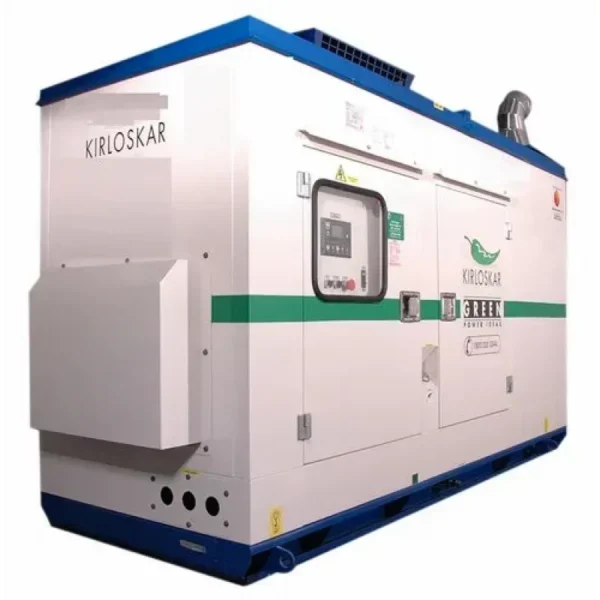
Quick answer: The Diesel Generator Working Principle involves two steps. Firstly, the diesel engine produces energy from burning fuel by the process of compression ignition, which results in the movement of pistons and the rotation of the crankshaft. Secondly, the mechanical energy generated due to the rotation of the crankshaft is converted into electrical energy using an alternator. There is no use of any spark plug throughout the process.
The rest of this guide breaks down every stage, part, and number behind that process.
What Is a Diesel Generator?
The diesel generator, or commonly called a genset, is defined as a system where electrical power is generated from a combination of a diesel engine and an alternator. The two systems combine to generate electricity through the use of diesel fuel.
A diesel generator has two main parts:
- Diesel Engine: Produces mechanical energy by burning diesel fuel and rotating the shaft of the engine.
- Alternator: Converts mechanical energy produced by the engine into electrical energy.
Diesel generators are used for backup power generation in hospitals, data centers, telecom masts, companies, and residential units. Where there is no grid connection available, diesel generators can be used to generate primary power.
Diesel Generator Working Principle: Step by Step
A diesel generator produces electricity by using a diesel engine to drive an alternator. First, the engine transforms energy from the diesel fuel to mechanical energy. Secondly, the alternator transforms the mechanical energy into electrical energy.
Here is how the process works from start to finish.
Step 1: Intake
The piston will move downward in the cylinder, and this will create space for the air to come into the cylinder through the intake valve. During this phase, only the air comes into the cylinder, not the diesel fuel.
Step 2: Compression
At this stage, the inlet valve will be closed because the piston will move upwards, resulting to compression of the air within the cylinder hence heating up of the air.
Step 3: Fuel Injection
The fuel injector injects the diesel oil in the form of fine spray near the end of the compression stroke, where it ignites spontaneously due to the heat of the compressed air without the use of spark plugs.
Step 4: Power Stroke
With combustion of the diesel, pressure is created within the engine that pushes the piston down and the motion is transferred to the crankshaft through the piston, which spins it. The rotation of the crankshaft powers the alternator.
Step 5: Exhaust
The exhaust valve is opened after the power stroke and the piston rises again to expel the burnt gases from the cylinder via the exhaust system. The process then starts all over again when the engine draws fresh air into the engine cylinders.
Step 6: Electricity Generation
Once the engine is turning over, that spinning crankshaft drives the alternator. Inside it, a magnetic field spins past the stator windings, and that’s what actually produces the electricity.
From there, a voltage regulator keeps the output steady, and the control system handles the rest monitoring the generator and sending power out to whatever’s plugged in.
Put simply: burn the fuel, move the pistons, turn the crankshaft, spin the alternator, get electricity.
Main Components and What Each One Does
Once you know what each part does, the diesel generator working principle stops feeling like a black box. Every component below has one job, and they only work as a system.
| Component | Function |
| Diesel engine | Burns fuel to create rotational force |
| Alternator | Turns that rotation into AC electricity |
| Fuel system | Stores, filters, and feeds fuel to the injectors |
| Voltage regulator | Keeps output voltage steady as the load changes |
| Cooling system | Pulls heat away using a radiator, coolant, and fan |
| Lubrication system | Cuts down friction and wear on moving parts |
| Exhaust system | Clears burnt gases and quiets the engine |
| Battery & starter | Gets the engine turning so combustion can begin |
| Control panel | Shows readings and handles start/stop |
| Frame & enclosure | Holds and protects everything else |
Worth flagging: dirty fuel wrecks more generators than almost anything else. That’s exactly why the fuel filters are there to catch water and grit before it reaches the injectors.
How Much Fuel Does a Diesel Generator Actually Use?
This question comes up a lot, and honestly, there’s no single number it all comes down to load. A diesel generator burns fuel most efficiently somewhere between 70% and 80% of its rated capacity. Run it lighter than that and you waste fuel per unit of power. Push it harder than that and you’re putting real strain on the engine.
As a rough guide, expect somewhere between 0.2 and 0.4 liters of fuel per kWh produced. Here’s what that translates to at 75% load, based on figures you’ll see across the industry:
| Generator Size | Approx. Fuel Use at 75% Load |
| 20 kVA | 4.5–5.5 L/hour |
| 50 kVA | 8–10 L/hour |
| 100 kVA | 17–20 L/hour |
| 250 kVA | 38–45 L/hour |
| 500 kVA | 75–85 L/hour |
| 1,000 kVA | 150–165 L/hour |
Two major errors in sizing cause most of the wastage. First, oversizing the engine for its actual load leads to “wet stacking” where the incomplete combustion of fuel leads to a buildup of fuel and carbon in the exhaust due to the low temperature attained by the engine. Undersizing leads to a continuous strain on the engine and increased fuel consumption. Proper sizing is the major key to fuel economy.
Generator Ratings: Standby, Prime, and Continuous
Not all diesel generators serve the same purpose. The manufacturers classify the generators into three types, and confusion between them causes engine failure.
- Standby rating: Designed to supply power as a backup in case of power outages. It operates at 100% capacity in terms of kW and usually offers an overload of 10% for one hour at a time.
- Prime power rating: Designed for areas without access to grid electricity, with the generator being the sole source of power and changing loads. Such generators employ engines that are about 25% bigger than those of a backup unit of the same capacity.
- Continuous rating: They are designed to operate at a constant, high load continuously. Just like prime-rated engines, the engine is also oversized compared to the standby engine.
If you’re buying a generator to run for hours a day rather than occasionally, a standby-rated unit is the wrong choice it will overheat and wear out fast.
Sizing a Diesel Generator: The Basic Formula
The rating of generators is done in kW and kVA. The relationship between the two depends on the power factor, which for most gensets that are used is 0.8:
kW = kVA × 0.8
Thus, a 500 kVA generator would provide about 400 kW of active power at this power factor. The following factors should be considered while selecting a generator:
- Continuous, average load that your equipment consumes
- Peak or surge load (electric motors and ACs may draw up to 3 times their average load when starting)
- Safety factor for future increase in load
Undersizing by considering only the average load, but ignoring the peak or surge load, is one of the most frequent and expensive sizing errors.
Types of Diesel Generators
By duty:
- Standby generators (backup only)
- Prime power generators (main power source, variable load)
- Continuous power generators (fixed, constant industrial load)
By portability:
- Portable units, wheel-mounted, for job sites and home backup
- Stationary units, permanently wired into a building
By phase:
- Single-phase, for homes and small offices
- Three-phase, for factories, hospitals, and heavy industrial loads
Diesel Generator vs. Petrol Generator
| Feature | Diesel | Petrol |
| Ignition | Compression (no spark plug) | Spark plug |
| Fuel efficiency | Higher | Lower |
| Typical lifespan | 15,000–20,000+ hours | Shorter |
| Upfront cost | Higher | Lower |
| Best fit | Continuous or heavy-duty use | Light, occasional use |
| Noise (no canopy) | Louder | Quieter |
For daily or heavy-duty power, diesel wins on running cost and durability. For occasional light use, petrol often wins on price and noise.
Why Diesel Generators Last Longer?
Diesel generators are known for their durability, fuel efficiency, and ability to operate under demanding conditions. Several design features help explain their long service life.
1. No Spark Plugs
The diesel engine employs compression ignition rather than spark plugs to initiate combustion. The spark plugs are not a part of the wear-and-tear components in a diesel engine.
2. Better Fuel Efficiency
Diesel oil has more energy compared to petrol in a liter, and diesel engines have higher efficiency compared to other engines. This will assist in minimizing fuel used by the generator.
3. Heavy-Duty Construction
Several diesel engines have robust internal parts and can withstand heavy workloads. However, their longevity will depend on several factors, including the design of the engine itself.
Why Are Diesel Generators Used for Critical Backup Power?
Diesel-powered generators are quite popular in hospitals, telecommunication towers, data centers, and commercial establishments as they are capable of supplying power during outages and can operate for a long period of time.
Nevertheless, diesel generators do not necessarily have a longer lifespan in all cases. The service life of a generator depends on its maintenance, quality of fuel, operating hours, loading, and quality of parts.
Common Applications
- Hospitals: Power essential equipment during an outage
- Data Centres: Avoid downtime and loss of data
- Construction Sites: Run equipment without any source of electricity
- Homes: Back up power supply during storms or outages
- Telecom Towers: Supply power to the site in absence of an electric grid
- Factories: Provide power to the production line
Maintenance Checklist
- Oil must be checked before each use; oil must be changed at the right time.
- Fuel and air filters should be replaced as required.
- Coolant levels should be checked and replenished as required.
- Battery charge and connections must be tested.
- The generator must be run regularly even when it is not being used.
- Keep an eye out for fuel leakage, unusual sounds, and smoke as early signs of a problem.
Most generator failures trace back to skipped maintenance, not manufacturing defects.
Final Thoughts
The diesel generator working principle boils down to one repeating chain: compressed air ignites fuel, fuel pushes pistons, pistons spin a crankshaft, and the crankshaft drives an alternator that produces electricity. Every component in the machine fuel system, cooling system, lubrication, and control panel exists to keep that chain running smoothly and safely.
Understanding this process isn’t just technical trivia. It’s what lets you size a generator correctly, catch problems early, and make sure backup power actually works when you need it most.
If you are looking for a reliable diesel generator in Nepal, BRT International supplies Kirloskar generators in different capacities for residential, commercial, and industrial applications. You can also explore the available Kirloskar generators in Nepal to find a suitable option for your power requirements.
Frequently Asked Questions
1. What is the working principle of a diesel generator?
A diesel generator burns fuel through compression ignition inside a diesel engine. The engine’s pistons turn a crankshaft, which spins an alternator. The alternator converts that motion into electricity through electromagnetic induction.
2. How does a diesel generator produce electricity?
The engine’s crankshaft spins a magnetized rotor inside the alternator. The rotor turns within a ring of copper coils called the stator. This movement creates a changing magnetic field, which pushes electrons through the coils and generates alternating current (AC).
3. Why doesn’t a diesel engine use a spark plug?
Diesel engines compress air so tightly that it heats up enough, on its own, to ignite the injected fuel. This is called compression ignition. Petrol engines use a lower compression ratio and need a spark plug to start combustion.
4. What are the main components of a diesel generator?
The core parts are the diesel engine, alternator, fuel system, cooling system, lubrication system, exhaust system, battery and starter, voltage regulator, control panel, and frame or enclosure.
5. What is the difference between a diesel generator and a petrol generator?
Diesel generators use compression ignition and run more fuel-efficiently over long periods, making them better for heavy or continuous use. Petrol generators use spark ignition, cost less upfront, and run quieter, making them better for light or occasional use.
6. How many types of diesel generators are there?
Diesel generators are commonly grouped by duty (standby, prime power, continuous power), by portability (portable or stationary), and by phase (single-phase or three-phase).
7. What is the RPM of a diesel generator?
Most diesel generators run at 1,500 RPM for 50 Hz power systems or 1,800 RPM for 60 Hz systems, depending on the country’s electrical standard.
8. How long can a diesel generator run continuously?
It depends on the rating. Portable units (5–100 kW) typically run 6 to 12 hours per tank. Stationary standby sets (50–1,000 kW) can run 24 to 72 hours. Prime power and continuous-duty machines (300 kW+) are built to run for hundreds of hours straight.
Popular Posts
Recent Posts
-
Kirloskar R Series vs SL Series: Which Generator Is Right for You?
Oct 06, 2026 | admin
-
Generator Overheating: Causes, Quick Fixes and Prevention Tips (Nepal Guide)
Oct 02, 2026 | admin
-
Diesel Generator Working Principle: The Complete Guide (2026)
Sep 27, 2026 | admin
-
Common Generator Problems in Nepal: Causes, Solutions, and Maintenance Tips
Sep 23, 2026 | admin
-
Generator Installation Cost in Nepal (2026): Complete Pricing & Buying Guide
Sep 10, 2026 | admin
-
IoT Enabled Genset: How Smart Generators Can Reduce Fuel Costs in Nepal
Sep 06, 2026 | admin
-
kVA vs kW: What’s the Difference? Simple Generator Power Guide
Sep 03, 2026 | admin
-
Best Generator for Hotel in Nepal (2026): Sizing, Silent Operation & Buying Guide
Aug 27, 2026 | admin